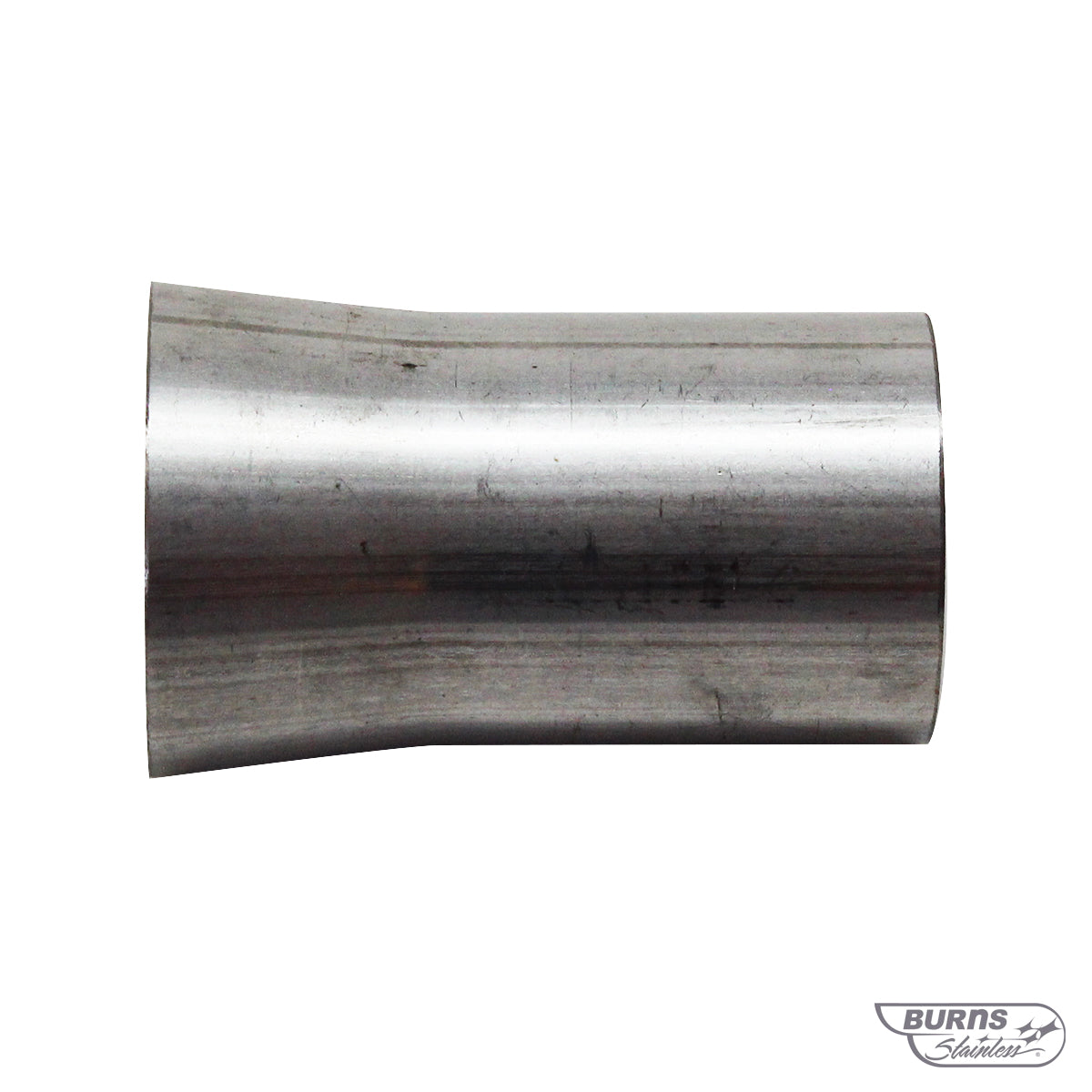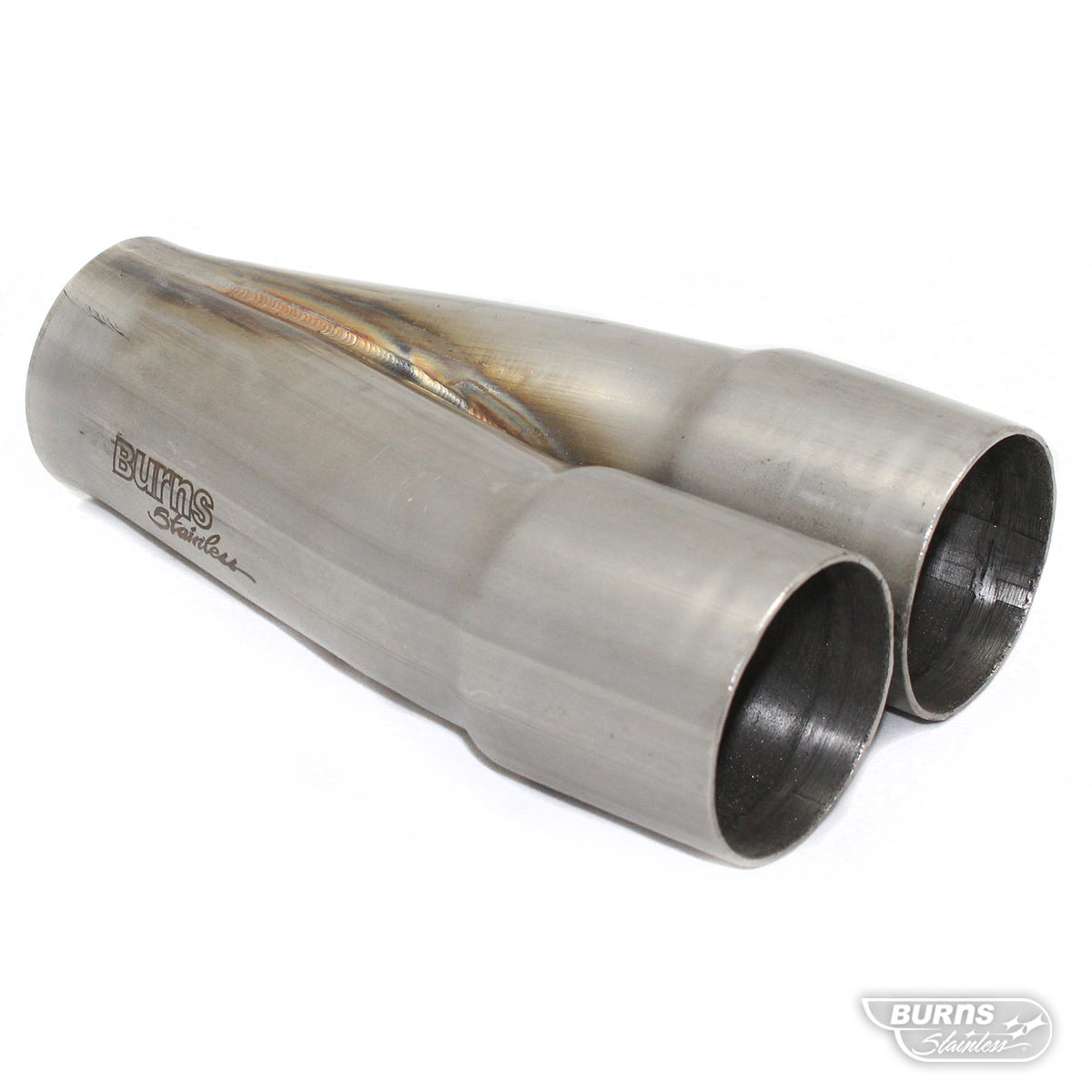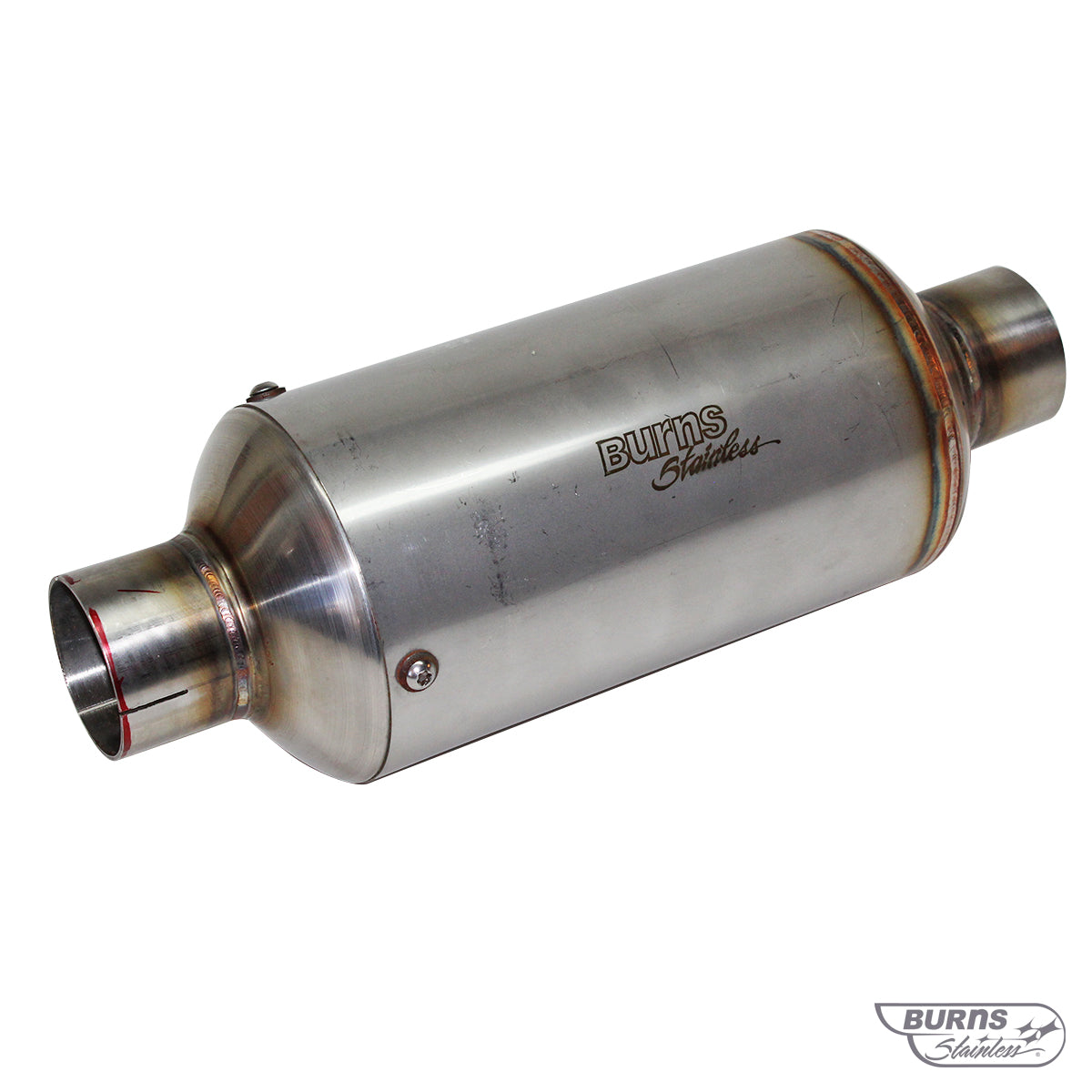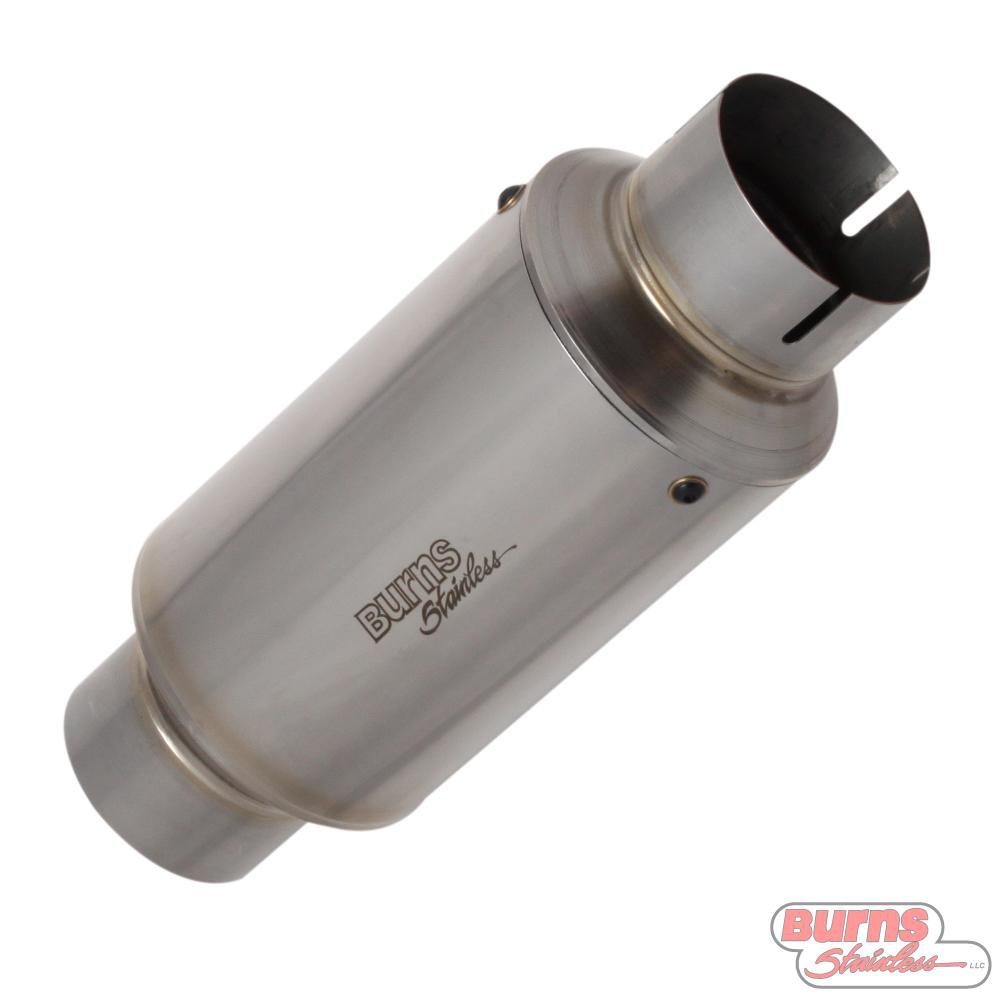
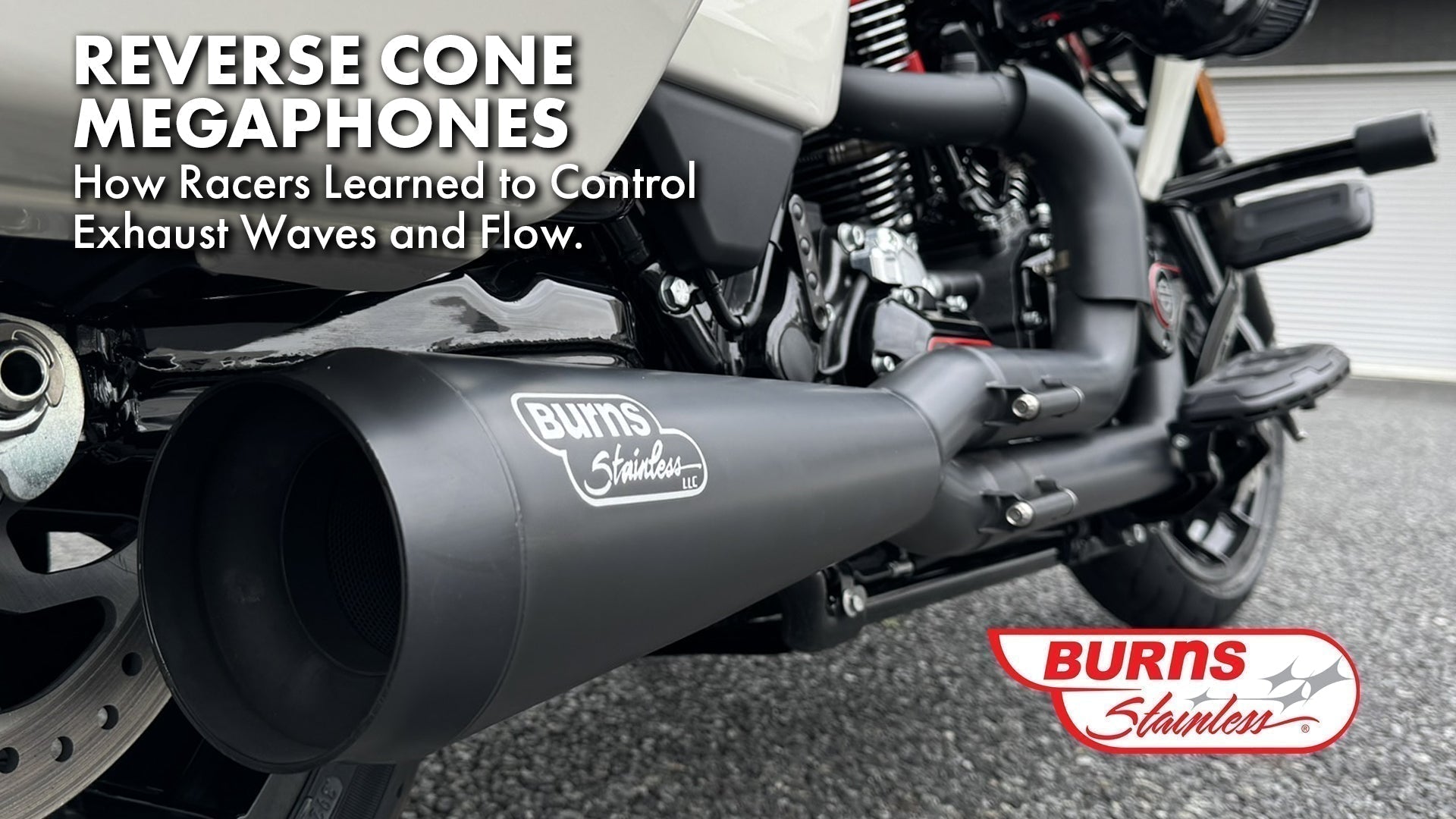
Reverse Cone Megaphone Mufflers are among the most recognizable components in motorcycle racing. Their tapered shape appeared on competition motorcycles long before engineers had modern computer simulations capable of showing what was happening inside the pipe.
By the early 1930s, British motorcycle manufacturers were experimenting with expanding exhaust outlets. Norton provides one of the best-documented examples: its factory racing motorcycles adopted megaphone exhausts for the 1934 season. These machines competed successfully in Grand Prix and Isle of Man TT racing, helping establish the megaphone as a serious performance component rather than a cosmetic exhaust tip.
Like many successful racing technologies, the megaphone was developed through a combination of theory, experimentation and results at the track.
Racers discovered that gradually expanding the exhaust after the primary pipes could improve cylinder scavenging and increase power. Open megaphones could produce impressive peak horsepower, but they could also make the engine peaky and difficult to tune. Small changes in length, cone angle or outlet diameter could substantially change where the engine made power.
Eventually, racers began adding a short cone that reduced the diameter at the end of the megaphone. This became known as the reverse cone.
The Reverse Cone Megaphone Muffler often broadened the useful powerband and made the engine less sensitive to a narrow tuning point. Racers knew it worked before they could fully explain why.
Today, the Reverse Cone Megaphone Muffler is commonly described as a simple combination of two reflected waves: the expanding megaphone creates a negative wave, and the reverse cone sends a positive wave back toward the engine.
That explanation is directionally correct, but incomplete.
A megaphone does not produce only one negative wave, and the reverse cone does more than generate a positive reflection. The complete system manages both pressure waves and the physical movement of exhaust gas and atmospheric air.
Understanding the difference between these effects helps explain why the reverse-cone megaphone has remained an effective racing exhaust design for generations.
From Early Racing Experiments to Modern Exhaust Development
Early exhaust development was largely empirical. Racers changed pipe lengths, diameters and cone shapes, then measured the results through acceleration, lap times and eventually dynamometer testing.
A change that produced more peak horsepower was not always faster on the track. An engine with a narrow powerband could be difficult to launch, difficult to shift and less responsive when engine speed fell outside its ideal range.
The open megaphone could make strong power at a particular engine speed, but its behavior was often abrupt. Adding a reverse cone could sacrifice little—or sometimes none—of that peak performance while making the engine pull across a wider operating range.
That made the motorcycle easier to race.
As testing methods improved, exhaust builders began to recognize that the pipe was not simply carrying exhaust gas away from the engine. It was also acting as an acoustic system in which pressure disturbances traveled through the exhaust gas, reflected from changes in area and returned toward the cylinder.
Modern modeling gives engineers a better view of these processes, but the basic geometry was proven on the racetrack long before the underlying behavior could be fully visualized.
Burns Stainless and Motorcycle Racing
Burns Stainless has worked with motorcycle and Harley-Davidson racers since 2000, incorporating Reverse Cone Megaphone Muffler and pressure-wave tuning into competition exhaust systems.
That work included exhaust development for Pro Stock racer Tom Bradford and other successful Harley racers. Bradford became a five-time AHDRA national champion, competed in NHRA Pro Stock Motorcycle and was one of the early racers in the class to run the quarter-mile in less than seven seconds.
Bradford and other racers won numerous races using exhaust systems that incorporated these principles.
Those racing programs provided something that theory alone cannot: repeated testing under actual competition conditions. Changes in primary length, collector design, megaphone angle, outlet diameter and reverse-cone geometry could be evaluated not only by peak dynamometer numbers, but also by how the motorcycle launched, accelerated through gear changes and performed throughout the usable RPM range.
The lessons learned from those programs continue to influence how Burns Stainless approaches high-performance motorcycle exhaust design today.
Exhaust Flow and Pressure Waves Are Different
To understand a megaphone, it is important to separate two related phenomena:
The physical movement of exhaust gas through the pipe
The movement of pressure waves through that gas
These are not the same thing.
The combustion gases move from the cylinder toward the exhaust outlet as mass flow. At the same time, pressure disturbances travel through those gases at approximately the local speed of sound.
A pressure wave can travel either with or against the direction of the exhaust flow. Exhaust gas may still be moving toward the outlet while a reflected pressure wave is traveling upstream toward the exhaust valve.
A useful exhaust system must therefore manage both:
How efficiently gas moves out of the engine
How pressure waves are timed and shaped within the system
Pipe length, diameter, taper and changes in cross-sectional area affect both processes.
What Happens at a Change in Area?
When a pressure wave reaches a change in pipe area, part of the wave continues through the transition and part is reflected.
A pressure wave traveling into an increase in area produces a negative, or rarefaction, reflection. A wave encountering a decrease in area produces a positive reflection.
he strength and duration of the reflection depend partly on how abruptly the area changes.
A sudden step to a larger diameter concentrates the reflection at one location. It therefore tends to generate a relatively distinct negative pulse.
A megaphone behaves differently because its area changes gradually over its entire length.
How a Reverse Cone Megaphone Muffler Produces a Scavenging Wave
A megaphone gradually increases in diameter from its inlet to its outlet. Instead of one abrupt expansion, it can be viewed as an extremely large number of nearly infinitesimal increases in cross-sectional area.
Each tiny area increase creates a correspondingly small negative reflection that travels back toward the engine.
Individually, these reflections are weak. Collectively, they form an extended rarefaction wave.
The megaphone therefore does not generate one large, sharp suction pulse at a single point. It produces a longer-duration, lower-amplitude negative wave built progressively along the length of the cone.
When that negative pressure reaches the exhaust valve at the correct time, it reduces pressure in the exhaust port. During valve overlap, this can help remove residual combustion gases and encourage the incoming charge to begin filling the cylinder.
Because the negative reflections are produced along the length of the cone, their return times are spread over a portion of the engine cycle. This can extend the scavenging influence across a broader RPM range than a single abrupt expansion.
The behavior depends on several dimensions:
Megaphone inlet diameter
Outlet diameter
Cone angle
Cone length
Position relative to the exhaust valve
Primary and collector dimensions
A megaphone is therefore more accurately understood as a wave-shaping device. It controls the timing, amplitude and duration of many small pressure reflections rather than producing one isolated negative wave.
Why an Open Megaphone Can Be Peaky
An open megaphone can produce excellent peak power when its dimensions match the engine and operating speed. However, it also leaves the large end of the cone directly exposed to the atmosphere.
This creates two important effects.
First, the open end forms a strong acoustic boundary. The waves reflected from that boundary can reinforce cylinder scavenging within a particular RPM range, but the effect may become less favorable when engine speed moves outside that range.
Second, when pressure inside the megaphone falls below atmospheric pressure, air can be drawn into the exhaust through the large open outlet.
This is actual reverse mass flow—not merely a pressure wave traveling upstream.
The low pressure generated by the megaphone is intended to help empty the cylinder. But if that pressure difference draws a large mass of outside air into the open end of the pipe, some of the megaphone’s pumping action is spent accelerating atmospheric air upstream.
That incoming air can alter the pressure field within the exhaust and reduce how effectively the low-pressure region acts at the exhaust valve.
The large opening of an unrestricted megaphone can therefore contribute to the narrow and sometimes abrupt power delivery racers experienced with early open designs.
Why Racers Added the Reverse Cone
The reverse cone reduces the diameter at the outlet of the megaphone.
Racers found that this relatively small addition could make an engine more responsive and broaden its useful powerband. In many applications, the motorcycle became less sensitive to falling slightly below or climbing above the ideal tuning speed.
The Reverse Cone Megaphone Muffler performs at least two related functions:
It changes the acoustic termination of the megaphone and produces positive reflected pressure energy.
It reduces the amount of atmospheric air that can physically flow back into the exhaust.
These effects occur simultaneously, but they are not the same mechanism.
The Positive Pressure Reflection
As an outgoing pressure wave enters the reverse cone, it encounters a progressively decreasing cross-sectional area. This contraction produces a positive pressure reflection that travels back into the megaphone.
The usual explanation suggests that this positive wave simply travels directly back to the engine. In reality, its path is more complicated.
Once the wave begins traveling upstream through the Reverse Cone Megaphone Muffler, it encounters a progressively decreasing area. The megaphone expands in the direction of exhaust flow, but from the perspective of a wave traveling back toward the engine, it is a gradual contraction.
That continuing change in area creates additional partial reflections.
Some of the positive pressure energy continues upstream. Some is reflected again toward the outlet. The positive wave is therefore repeatedly divided, reshaped and distributed within the cone.
This means the megaphone and reverse cone behave as a coupled acoustic system—not as two completely independent wave generators.
It may be useful to think of the geometry as temporarily retaining or recirculating some of the reflected energy within the megaphone. However, describing the wave as completely “trapped” would be too strong. Pressure energy continues to be transmitted, reflected and dissipated.
The essential point is that the reverse cone does not necessarily launch one undisturbed positive pulse directly back at the exhaust valve. The changing cross-sectional area continues to shape that reflected energy.
Reducing Reverse Mass Flow from the Atmosphere
The reverse cone also performs a function that pressure-wave reflection alone does not fully explain.
When pressure inside an open megaphone drops below atmospheric pressure, outside air can begin flowing into the exhaust. The larger the outlet, the easier it is for a substantial mass of air to be accelerated upstream.
The smaller opening created by the reverse cone limits that reverse mass flow.
The cone does not seal the exhaust, and it does not operate as a one-way valve. Both exhaust gas and pressure waves can still pass through the outlet. However, the reduced outlet area makes it more difficult for a large volume of atmospheric air to enter the system during a brief period of sub-atmospheric pressure.
This distinction is important:
A pressure wave can travel through a gas without requiring the entire mass of gas to move with it.
>The reverse cone can therefore maintain the desired acoustic interaction at the end of the megaphone while reducing the physical amount of outside air drawn into the exhaust.
That allows more of the low-pressure activity produced by the megaphone to act within the exhaust tract, where it can help scavenge the cylinder, instead of being consumed by uncontrolled airflow entering through the outlet.
Controlling Overscavenging During Valve Overlap
A properly timed negative wave can improve scavenging, but more scavenging is not always better.
During valve overlap, both the intake and exhaust valves are partially open. A strong negative pressure at the exhaust valve can help initiate intake flow and remove residual combustion gases.
If the negative pressure is too strong, lasts too long or arrives at the wrong time, it can draw part of the fresh intake charge through the cylinder and into the exhaust.
This is sometimes called overscavenging.
Positive pressure reflected by the reverse cone may help limit this process when it returns at the appropriate time. The positive wave can raise pressure near the exhaust valve and reduce the tendency for fresh mixture to continue escaping into the pipe.
This is one reason Reverse Cone Megaphone Muffler dimensions must be matched to the engine rather than selected independently.
The goal is not simply to create the largest possible negative wave or the strongest possible positive reflection. The goal is to create the appropriate pressure conditions at the exhaust valve at the correct points in the engine cycle.
How the Reverse Cone Megaphone Muffler Broadens the Powerband
The reverse cone changes several aspects of the exhaust simultaneously:
It modifies the acoustic boundary at the end of the megaphone.
It creates positive reflected pressure energy.
It reduces reverse atmospheric mass flow.
It alters how pressure energy is distributed within the cone.
>It can help control excessive charge loss during valve overlap.
It changes the RPM range over which the megaphone is effective.
Together, these effects can produce a broader and more manageable powerband than an open megaphone.
That broader powerband was especially valuable to racers. A motorcycle does not remain at one exact engine speed throughout a run. RPM falls after each shift and then climbs again. An exhaust that works across a wider range can accelerate the motorcycle more effectively even if its peak dynamometer number is similar to that of a narrower system.
This helps explain why racers continued using reverse-cone megaphones after discovering them experimentally. The design did not merely look different on a dyno graph. It often made the motorcycle easier and faster to race.
The Megaphone and Reverse Cone Must Be Designed as One System
A Reverse Cone Megaphone Muffler should not be treated as a megaphone with an arbitrary restriction attached to its outlet.
The megaphone and reverse cone form a single acoustic and aerodynamic system.
The expanding megaphone produces a long-duration, relatively low-amplitude rarefaction wave through a series of small area changes. The reverse cone changes the outlet boundary, produces positive reflected energy and reduces the amount of atmospheric air that can enter the pipe.
The returning positive pressure then encounters the megaphone as a gradual contraction, creating further partial reflections that reshape and redistribute the wave.
Cone angle, length and outlet diameter must therefore be considered together in the Reverse Cone Megaphone Muffler with:
Engine displacement
Exhaust-valve timing
Camshaft overlap
Cylinder-head airflow
Intended RPM range
Primary-tube diameter and length
Collector geometry
Vehicle weight, gearing and racing application
There is no universal Reverse Cone Megaphone Muffler dimension that is ideal for every engine.
A smaller outlet may strengthen certain pressure effects and further limit reverse atmospheric flow, but too small an outlet can create excessive resistance to forward exhaust flow.
A larger outlet may support greater high-RPM mass flow, but it may provide less control over atmospheric reversion and change the reflected-wave behavior.
The successful design is a balance.
This Is Not “Backpressure”
The operation of a reverse-cone megaphone is sometimes explained by saying that an engine needs backpressure.
That is misleading.
Backpressure is resistance to forward exhaust flow. Excessive backpressure makes it more difficult for the cylinder to empty and generally costs power.
What a naturally aspirated performance engine can benefit from is properly timed pressure-wave activity and controlled gas motion.
A reverse cone is not added simply to obstruct the exhaust. Its geometry is selected to influence:
Pressure-wave timing
Wave amplitude and duration
Exhaust-gas velocity
Cylinder scavenging
Reverse mass flow
Charge loss during valve overlap
The width and position of the usable powerband
Restriction may be one consequence of reducing outlet area, but restriction itself is not the objective.
Racing Results Remain the Final Test
Computer simulation and engine modeling have greatly improved exhaust-system development. They allow engineers to evaluate wave timing, gas velocity, temperature and pressure throughout the engine cycle.
But racing remains an essential test.
An exhaust system must operate through launches, gear changes, rapidly changing engine speeds and real engine temperatures. It must make useful power—not merely produce an impressive number at one point on a graph.
The Reverse Cone Megaphone Muffler survived because it repeatedly demonstrated its value in competition.
Burns Stainless’s work with Tom Bradford and other Harley racers beginning in 2000 helped apply these principles to some of the most demanding naturally aspirated motorcycle engines in the sport. Their race victories and championship-level performances showed how carefully developed cone and collector geometry could convert pressure-wave theory into measurable results on the track.
Conclusion
The Reverse Cone Megaphone Muffler was born from racing experimentation and refined through decades of competition.
Its operation cannot be fully explained as one negative wave followed by one positive wave.
The Reverse Cone Megaphone Muffler's gradual expansion produces a long-duration, comparatively low-amplitude rarefaction wave made up of many small reflections. The reverse cone creates positive reflected pressure energy, changes the acoustic termination of the system and reduces reverse mass flow from the atmosphere.
As the positive pressure travels back through the Reverse Cone Megaphone Muffler, it encounters a progressively decreasing area that continues to divide and reshape the wave.
The complete system therefore manages both acoustics and gas flow:
It promotes cylinder scavenging.
It controls the timing and duration of reflected pressure.
It reduces uncontrolled atmospheric inflow.
It can limit overscavenging during valve overlap.
It broadens the engine’s useful operating range.
That combination of pressure-wave control, mass-flow control and race-proven development is why the reverse-cone megaphone remains one of the most enduring designs in high-performance motorcycle exhaust engineering.