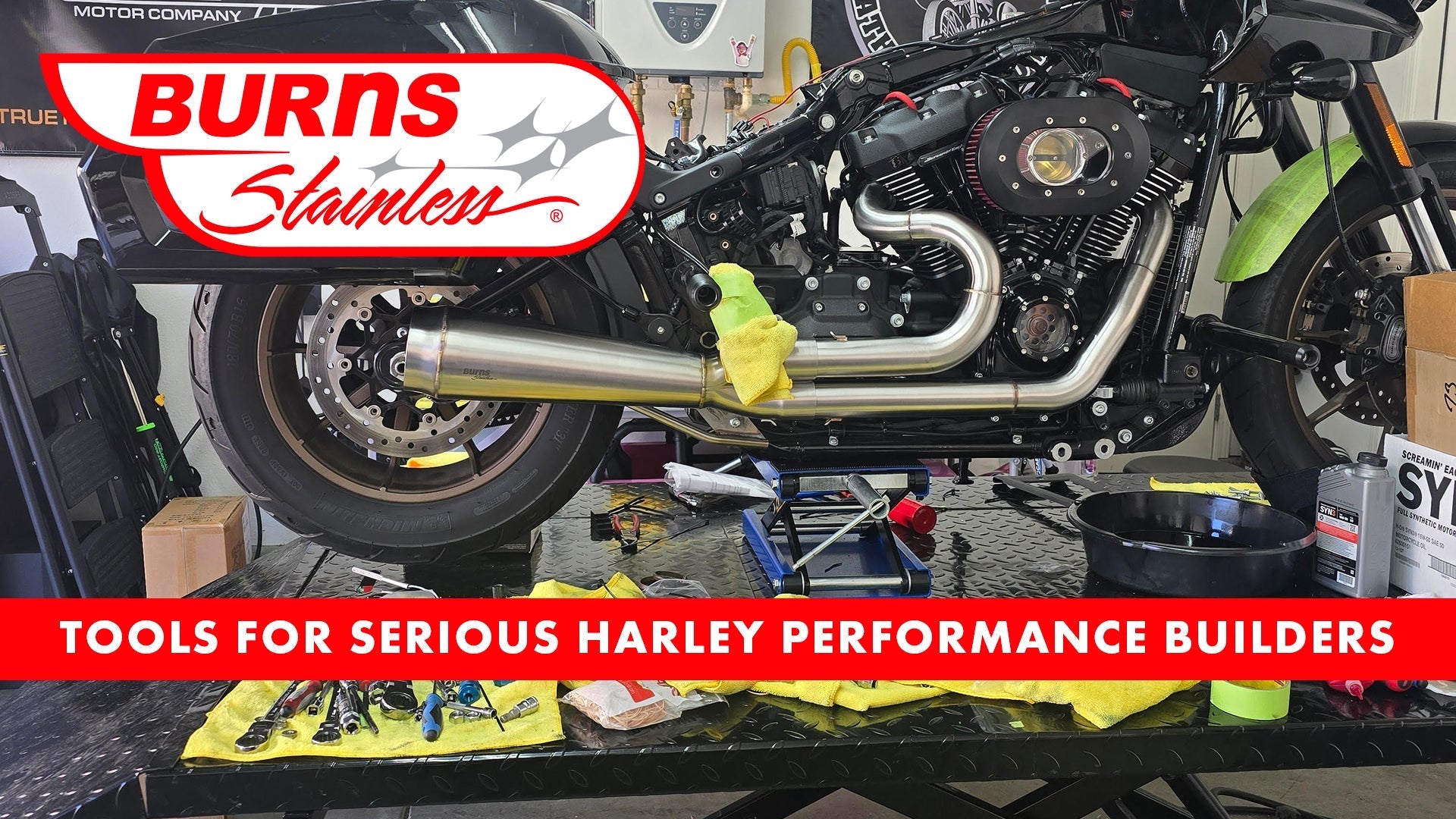
Building a serious Harley-Davidson performance motorcycle takes more than a socket set and a pile of aftermarket parts.
Once you move beyond basic bolt-on modifications, the job becomes increasingly about measurement, diagnosis, precision and verification. Whether you're building a Milwaukee-Eight street bike, a high-horsepower bagger, a drag bike or a custom V-Twin, having the right tools can make the difference between simply installing parts and actually building a complete performance package.
The best Harley builders don't just replace parts until something improves. They measure what's happening, diagnose problems, verify clearances and test the results.
Here are 10 tools—or categories of tools—that belong in the serious Harley performance builder's arsenal.
1. Quality Torque Wrenches
Few tools are more important to engine and motorcycle assembly than a properly calibrated torque wrench.
Harley engines and motorcycles contain plenty of aluminum components, threaded holes, engine fasteners, exhaust flanges and drivetrain components where overtightening can damage parts and undertightening can lead to leaks or fasteners coming loose.
Serious builders will typically need both inch-pound and foot-pound torque wrenches to cover the wide range of fasteners found throughout a motorcycle.
The lesson is simple:
Torque specifications aren't suggestions.
Proper torque helps maintain clamping force, protects threads and gives the builder repeatable results every time the motorcycle comes apart and goes back together.
2. Motorcycle Lift or Heavy-Duty Motorcycle Jack
A good motorcycle lift isn't simply about making the job more comfortable.
 It gives the builder a stable working platform and a much better view of the entire motorcycle.
That becomes particularly important when installing or fabricating exhaust systems, adjusting suspension, removing wheels or evaluating clearance around the engine and chassis.
A lift makes it easier to inspect:
- Exhaust-to-frame clearance
- Ground clearance
- Suspension travel
- Belt and chain clearance
- Oil and brake lines
- Rider controls
- Wiring
- Exhaust mounting points
Performance motorcycles often package a tremendous number of components into a very small amount of space. Being able to inspect the motorcycle from multiple angles can reveal problems that are difficult to see while working on the floor.
3. Digital Calipers
A serious builder eventually has to stop eyeballing dimensions.
 Digital calipers are one of the simplest ways to begin making accurate measurements throughout a motorcycle build.
They can be used to measure:
- Exhaust tubing
- Collector and muffler dimensions
- Flange thickness
- Bolt and shaft diameters
- Spacers
- Gaskets
- Brake components
- Fabricated parts
- Material thickness
When fitting performance exhaust components, engine parts or custom fabricated pieces, small dimensional differences can become important.
Performance parts live in a world measured in thousandths—not “close enough.”
Calipers are relatively simple tools, but they encourage one of the most important habits in performance building: measure first.
4. Compression Tester and Leak-Down Tester
Before chasing horsepower, make sure the engine is mechanically healthy.
A compression test provides a useful snapshot of cylinder pressure. A cylinder leak-down test goes further by helping determine how well the combustion chamber is sealing and potentially where pressure is escaping.
Leakage can point toward problems involving:
- Piston rings
- Intake valves
- Exhaust valves
- Valve seats
- Head sealing
- Cylinder condition
This information is especially valuable before installing cams, cylinder heads, intake systems, exhaust systems or other performance upgrades.
There is little value in attempting to tune around a mechanical problem.
A good performance-building rule is:
Diagnose before you modify.
5. Digital Multimeter
Modern Harley performance isn't purely mechanical.
 Today's motorcycles rely heavily on electronic engine management, sensors, fuel injection, electronic throttle control and increasingly complex wiring.
A quality digital multimeter can help diagnose:
- Battery voltage
- Charging system problems
- Poor grounds
- Wiring faults
- Switches
- Sensors
- Electrical accessories
- Ignition-related problems
Electrical problems can sometimes imitate mechanical or tuning problems. A weak battery, bad connection or poor ground can send a builder chasing an engine problem that isn't actually inside the engine.
Learning basic electrical diagnosis can save hours of parts swapping and guesswork.
6. Motorcycle Scan and Diagnostic Tool
The scan tool has become one of the essential tools for anyone seriously working with late-model Harley motorcycles.
Modern Milwaukee-Eight and electronically controlled Harley platforms can provide a tremendous amount of information through the motorcycle's engine-management system.
Depending on the diagnostic system being used, builders may be able to monitor or investigate information involving:
- Diagnostic trouble codes
- Oxygen sensors
- Throttle position
- Engine temperature
- Engine speed
- Electronic throttle control
- Fuel-related conditions
- Sensor faults
A scan tool can tell you what the motorcycle's electronics are seeing.
However, there is an important distinction:
Diagnostics and tuning are not necessarily the same thing.
A diagnostic tool helps identify problems and monitor operating information. Tuning software and equipment are used to alter engine-management parameters.
Serious performance work often requires understanding both.
7. Dial Indicator and Degree Wheel
This is where the tool collection begins moving from motorcycle maintenance toward actual engine building.
When changing cams, cylinder heads, compression ratios or other internal engine components, builders need ways to verify what's physically happening inside the engine.
A dial indicator can be used for precision measurements involving component movement and positioning. Combined with a degree wheel, it allows an engine builder to verify cam and valve events relative to crankshaft position.
This can become particularly important when checking an engine combination involving:
- Performance camshafts
- Modified cylinder heads
- Increased compression
- Piston-to-valve clearance
- Custom engine combinations
The principle here is:
Trust the parts. Verify the engine.
Published specifications are valuable, but serious engine building requires confirming how the actual combination fits and operates.
8. Thread Chasers, Taps and Dies
Anyone who works on motorcycles long enough eventually encounters damaged or contaminated threads.
 Harley exhaust studs alone can make thread-maintenance tools worth having.
A thread-restoration set can help with engine cases, brackets, mounts, fabricated components and countless fasteners throughout a motorcycle.
There is also an important difference between cleaning threads and cutting new ones.
A thread chaser is generally designed to restore or clean an existing thread while removing minimal material. A traditional tap or die is designed to cut threads and may remove material from the part.
Knowing which tool the job requires can help preserve valuable engine and chassis components.
9. Quality TIG Welding Equipment
Not everyone working on a Harley needs a welder.
But once you're calling yourself a motorcycle builder, fabrication eventually becomes part of the equation.
Custom exhaust systems, brackets, mounting tabs and other fabricated components require the ability to securely join metal while controlling fit, penetration and heat.
For stainless steel exhaust fabrication, TIG welding offers excellent control and allows experienced fabricators to produce clean, strong welds.
Proper stainless exhaust fabrication also involves much more than simply joining two pieces of tubing. Factors include:
- Proper fit-up
- Material selection
- Heat control
- Joint preparation
- Shielding gas
- Back purging
- Welding technique
At Burns Stainless, these considerations are part of building high-performance exhaust components designed for demanding motorsports applications.
And there is an important distinction worth making:
Owning a TIG welder doesn't automatically make someone a TIG welder.
Good welding and fabrication are skills developed through training, practice and experience.
10. The Tool You Don't Necessarily Need to Own: A Chassis Dyno
Most home builders aren't going to put a chassis dynamometer in the garage.
 But every serious performance builder should have access to a good dyno and an experienced operator or tuner.
The dyno replaces opinions with measurable information.
Depending on the testing equipment and setup, dyno testing can help evaluate:
- Horsepower
- Torque
- Power delivery through the RPM range
- Air/fuel behavior
- Tuning changes
- Before-and-after modifications
- Overall engine combinations
Peak horsepower is only part of the story.
A strong performance motorcycle should deliver power where the rider actually needs it. Depending on the application, improving torque or broadening the usable powerband may be far more important than simply producing the largest number at the top of a dyno chart.
This is also why exhaust design needs to be considered as part of the entire engine combination rather than as an isolated component.
Performance Is a System
The most important tool in a Harley performance shop may ultimately be the builder's ability to understand how everything works together.
A camshaft doesn't operate independently of compression.
Cylinder heads don't operate independently of displacement, airflow or RPM.
An intake system doesn't operate independently of the tune.
And a performance exhaust is more than something bolted onto the exhaust ports to change the sound of the motorcycle.
Primary diameter, primary length, collector design, collector outlet size, muffler configuration, engine displacement, cam timing and intended operating RPM can all influence how a performance engine behaves.
That's why serious builders follow a process:
Measure. Diagnose. Build. Verify.
Installing performance parts is relatively easy.
Building a motorcycle where the parts work together as a complete system takes considerably more knowledge.
Three More Harley Builder Tools Worth Having
Once the basics are covered, several relatively simple tools can become surprisingly valuable around a performance shop.
Honorable Mention #1: Borescope
A compact inspection camera can give a builder a look inside places that would otherwise require significant disassembly.
Depending on the application, a borescope may help inspect areas such as cylinders, combustion chambers, ports and other difficult-to-see locations.
It doesn't replace proper engine inspection, but it can be an extremely useful diagnostic tool.
Honorable Mention #2: Infrared Thermometer
An infrared thermometer offers a fast way to compare surface temperatures throughout the motorcycle.
It can be useful when investigating unusual heat patterns, comparing cylinder or exhaust temperatures and troubleshooting components after the motorcycle has been operated.
Again, the goal is information.
Instead of saying, “That seems hot,” the builder has a measurement to work from.
Honorable Mention #3: Fabrication Measuring Tools
As the build becomes more custom, basic machinist and fabrication tools become increasingly useful.
Consider adding:
- Digital angle finder
- Machinist square
- Quality straightedge
- Radius gauges
- Layout tools
- Welding fixtures and clamps
A beautifully fabricated motorcycle usually starts long before the welding torch is turned on.
It begins with accurate layout and measurement.

Frequently Asked Questions About Harley Performance Tools
What tools do I need to build a Harley performance engine?
At minimum, a serious Harley engine builder should have accurate torque wrenches, measurement tools, compression and leak-down testing equipment, diagnostic equipment and specialty tools appropriate to the engine being assembled. More advanced engine work may also require dial indicators, degree wheels and precision measuring equipment.
Do I need a dyno after installing Harley performance parts?
Not every modification requires dyno testing, but dyno access becomes increasingly valuable when cams, cylinder heads, larger-displacement engines, intake changes, exhaust systems and engine-management tuning are combined. A dyno allows builders and tuners to evaluate the complete combination rather than relying solely on how the motorcycle feels.
What tools are needed for Harley exhaust fabrication?
Custom stainless steel exhaust fabrication typically requires accurate measuring and layout equipment, cutting and fit-up tools, appropriate welding equipment and the skill to properly weld stainless steel. Professional exhaust fabrication may also involve fixtures, back-purge equipment and specialized tubing fabrication tools.
Why are measuring tools so important when building a performance motorcycle?
Performance building depends on knowing actual dimensions, clearances and operating conditions. Accurate measurement allows the builder to verify that components fit correctly and operate within the required specifications instead of relying on assumptions.
What separates a Harley builder from someone installing bolt-on parts?
The biggest difference is process. Serious builders measure components, diagnose problems, verify clearances, fabricate when necessary and test the finished combination. Installing parts is one part of the job; understanding how those parts interact is what turns the project into an engineered performance build.
Build With Information, Not Guesswork
There will always be another specialty tool worth adding to the toolbox.
But the real value of these tools isn't simply owning them.
It's what they allow you to learn about the motorcycle.
The better you can measure, diagnose and verify what's happening inside a performance Harley, the better your chances of building an engine and exhaust combination that delivers the result you were actually looking for.
At Burns Stainless, that same philosophy drives the development of performance exhaust systems and components: understand the engine, understand the application and design the exhaust around what the complete combination needs.