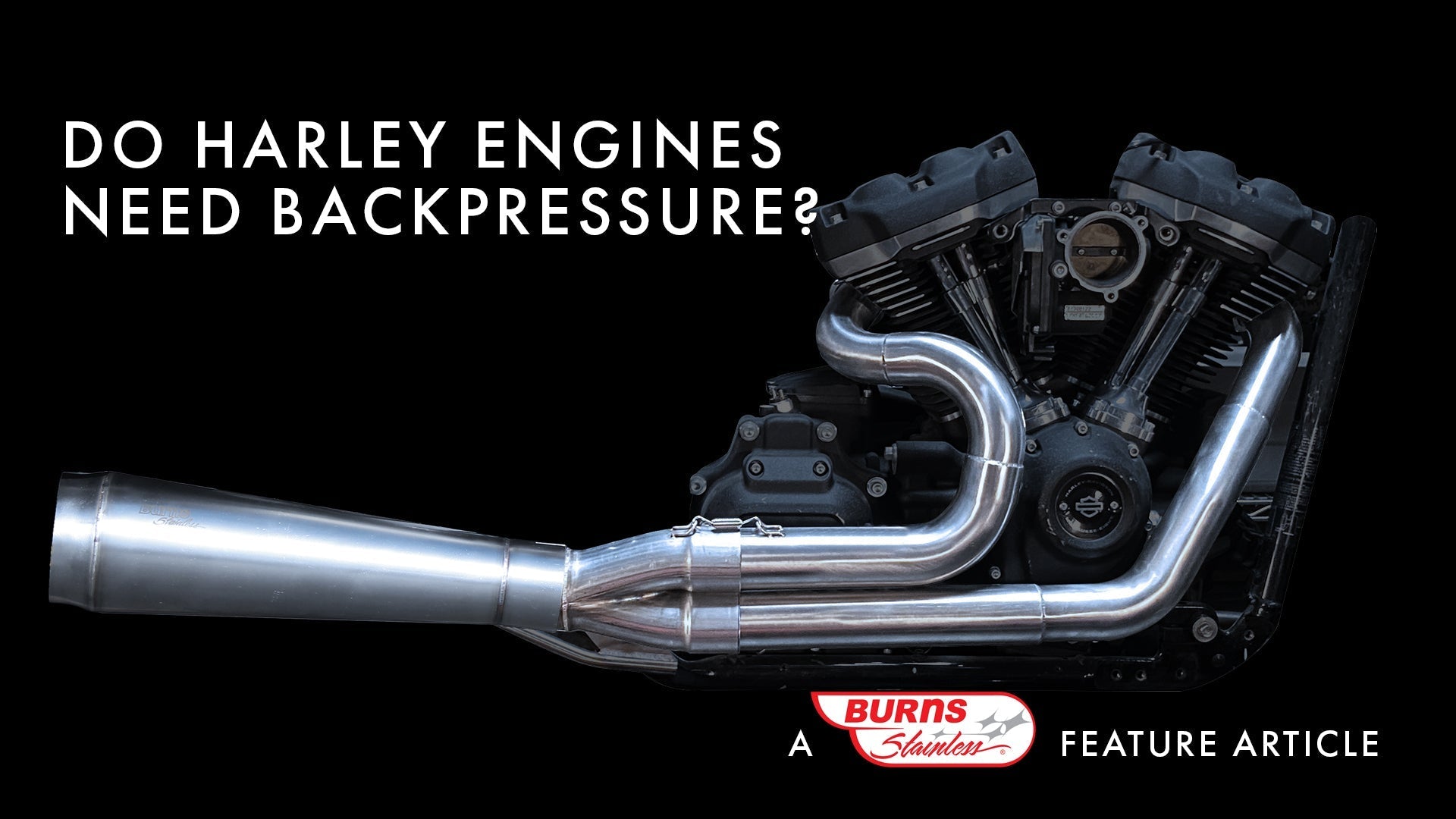
Overlap, Scavenging, and High-Performance Milwaukee-Eight Exhaust Tuning
From time to time we see claims like this:
“Stock Harley cams don’t have overlap.”
“Harley engines need 7 psi of backpressure to make power.”
Let’s examine that from an engineering standpoint — especially in the context of high-performance Milwaukee-Eight (M8) engines.
 Race Cam Overlap in a High-Performance M8
Consider the Ward Performance W586 M8 camshaft, commonly used in serious 131–135 cubic inch Harley builds.
At .050" cam lift (1.6:1 rocker ratio):
- Intake opens 22° BTDC
- Exhaust closes 15° ATDC
That equals 37 degrees of valve overlap at .050".
Valve overlap means both intake and exhaust valves are open at the same time. In high-performance Harley engines, overlap is intentional. It allows the exhaust system to assist cylinder evacuation through scavenging.
Large-overlap camshafts are common in performance M8 builds because they support improved cylinder filling at higher RPM.
Do Stock Harley Cams Have Overlap?
Yes.
A stock Milwaukee-Eight 107 cam at .050" lift:
- Intake opens 6° BTDC
- Exhaust closes 3° ATDC
That equals 9 degrees of overlap.
Even factory Harley-Davidson camshafts use overlap as part of normal four-stroke engine breathing strategy.
The difference between stock and performance engines is not whether overlap exists — it’s how much.
What Is Backpressure in a Harley Exhaust System?
Backpressure is static exhaust pressure resisting flow out of the cylinder.
At sea level, atmospheric pressure is about 14.7 psi.
Seven psi of backpressure equals nearly 48% of atmospheric pressure.
On a 4.25" bore Milwaukee-Eight piston (about 14.2 square inches of area), 7 psi creates approximately:
100 pounds of force resisting the piston during the exhaust stroke.
That is pumping loss.
High-performance Harley engines are designed to reduce pumping losses — not increase them.
Why the “Harley Needs Backpressure” Myth Exists
Open drag pipes are known to cause midrange torque loss on Harley engines.
When riders install more restrictive mufflers and torque improves, it appears that the engine “needed backpressure.”
What actually changed was exhaust wave behavior.
Primary tube length, collector design, and exhaust geometry determine how pressure waves reflect and return to the exhaust valve during overlap.
A properly timed negative pressure wave improves scavenging.
Static backpressure does not.
The torque gain often attributed to “backpressure” is typically the result of improved pressure wave timing — not added static pressure.
Scavenging vs. Backpressure in Performance Harley Engines
Scavenging occurs when a negative pressure wave arrives at the exhaust valve during overlap, helping evacuate residual exhaust gases and support intake charge movement.
Backpressure is simply resistance.
As cam overlap increases — like the 37° seen in race-oriented M8 camshafts — the engine becomes more sensitive to exhaust tuning. Proper collector design and pressure wave control become critical for performance.
High-performance Harley exhaust systems are engineered to optimize scavenging, not create restriction.
The Bottom Line
- Performance M8 cams often run substantial valve overlap.
- Even stock Harley camshafts have measurable overlap.
- 7 psi of backpressure represents significant pumping loss.
- Torque improvements often attributed to “backpressure” are typically pressure wave effects.
- High-performance Harley engines respond to scavenging and exhaust tuning — not static restriction.
Backpressure is resistance.
Scavenging is physics.
And physics determines horsepower.