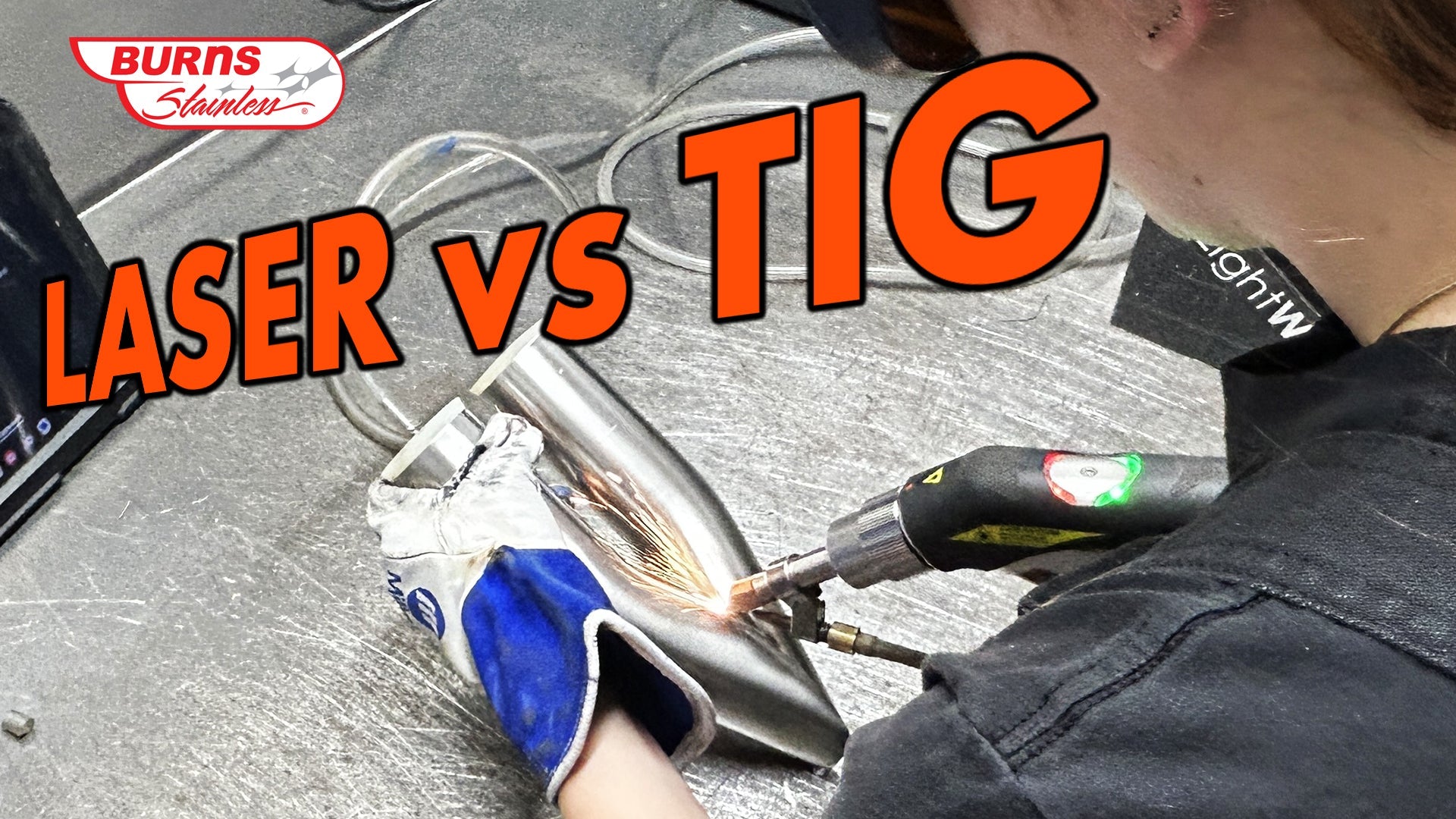
When most people picture a high-quality stainless steel exhaust being fabricated, they picture a TIG torch, a skilled welder and a perfectly stacked weld bead.
TIG welding has earned that reputation. It has been a cornerstone of professional motorsports and performance exhaust fabrication for decades.
But manufacturing technology continues to evolve.
At Burns Stainless, we have added laser welding to our fabrication capabilities alongside traditional TIG welding. In this episode of Vince in Shorts, Vince Roman takes us inside the Burns Stainless laser welding room for a direct comparison of laser welding vs. TIG welding on stainless steel exhaust collectors.
The objective isn't to declare one process the universal winner.
It's to understand what each process brings to high-performance exhaust manufacturing—and why controlling the process matters just as much as the welding technology itself.
TIG Welding vs. Laser Welding: A Real-World Collector Test
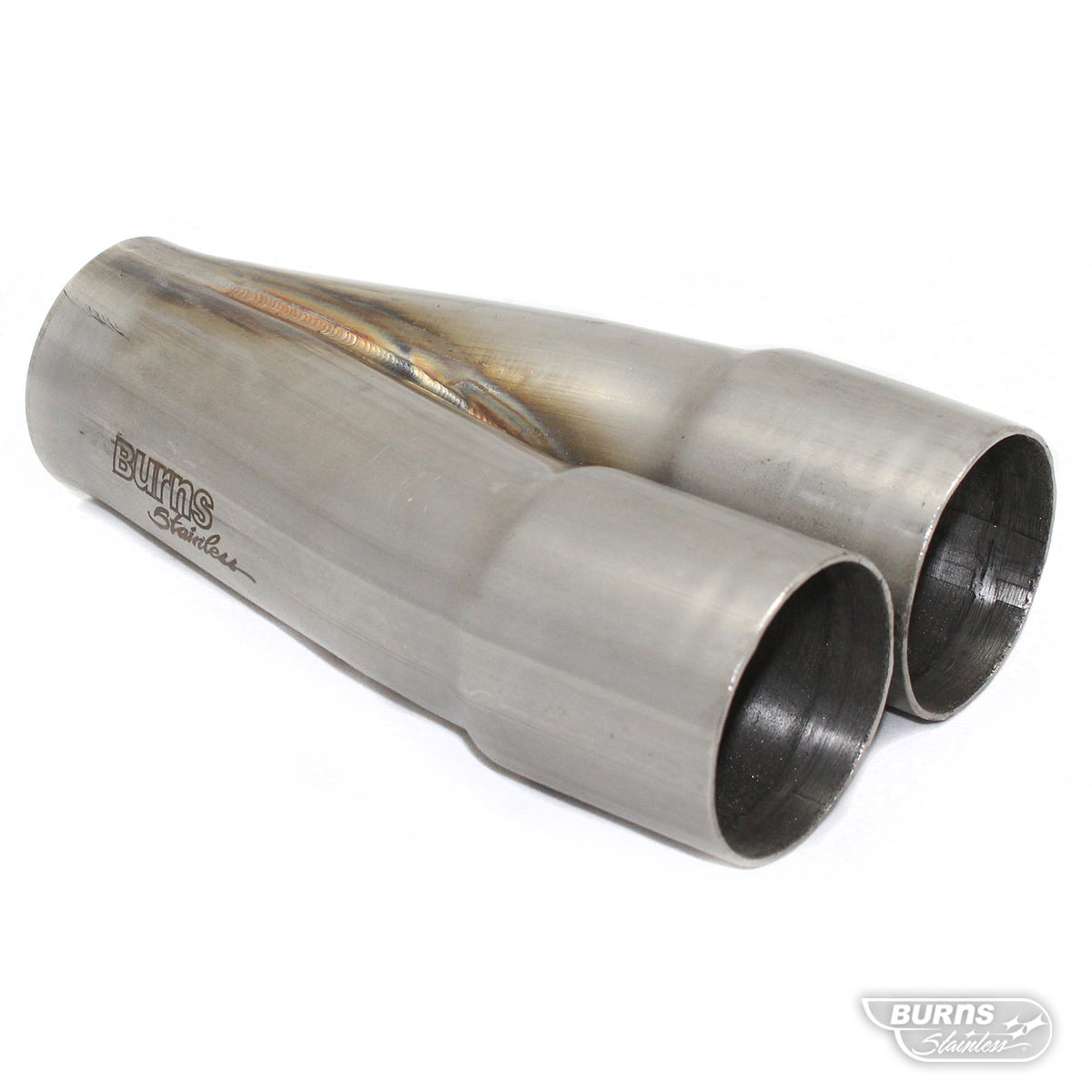
For the comparison, the Burns Stainless fabrication team prepared two identical 2-into-1 merge collectors.
Both collectors were:
- Cut
- Laid out
- Fit
- Tack welded
- Prepared for final welding
Burns Stainless fabricator Maddie then welded one collector at her TIG welding station using a Miller TIG welder.
The second collector was welded using the Burns Stainless IPG laser welding system.
That gives us a much more useful comparison than simply discussing specifications on paper. These are two welding processes being applied to essentially the same performance exhaust component under actual shop conditions.
Why TIG Welding Remains a Performance Fabrication Standard
TIG—or Gas Tungsten Arc Welding—offers exceptional control over the weld.
That control is one of the primary reasons TIG welding has been used throughout motorsports, aerospace and high-end stainless steel fabrication for generations.
For an experienced fabricator, TIG welding provides precise control over heat input, filler material and the weld puddle.
That makes it extremely versatile when building components such as:
- Stainless steel headers
- Merge collectors
- Exhaust transitions
- Megaphones
- Mufflers
- Inconel exhaust components
- Custom racing exhaust systems
For specialized fabrication or assemblies that require the welder to continually adjust to changing joint geometry, TIG welding remains an exceptionally valuable tool.
But TIG welding also takes time.
That becomes increasingly important when producing performance exhaust components consistently and efficiently.
Where Laser Welding Changes the Equation
Laser welding approaches the job differently.
Rather than producing a conventional arc, the welding system concentrates energy into a highly focused laser beam.
The result can be an extremely fast, narrow and controlled weld.
At Burns Stainless, the IPG laser welding system can be configured for several materials used throughout performance fabrication, including:
- Stainless steel
- Inconel
- Mild steel
- Aluminum
For the merge collector demonstrated in the video, Burns Stainless Shop Foreman Adam explains that the machine is programmed with settings developed specifically for the application.
One of those settings is approximately 320 watts of power, selected to produce the penetration required for the joint while controlling heat input.
That balance is important.
Less Heat Can Mean Less Distortion
Excessive heat can distort thin-wall tubing and complex fabricated components.
Laser welding allows Burns Stainless to concentrate energy very precisely at the weld joint, reducing unnecessary heat soak into the surrounding material.
That can offer several manufacturing advantages:
Reduced distortion. Less heat transferred into the surrounding tubing can help the component maintain its intended geometry.
Fast welding speeds. Once the process and machine settings have been properly developed, laser welding can complete certain production welds considerably faster than conventional TIG welding.
Consistent weld profiles. Proper machine setup makes it possible to repeat a developed welding process from component to component.
Clean weld appearance. Laser welding can produce an exceptionally narrow, clean weld bead.
But getting those results requires much more than pointing a laser at two pieces of stainless steel.
Laser Welding Is a Process, Not a Shortcut
One of the interesting parts of laser welding is the amount of control available within the machine.
The Burns Stainless team adjusts parameters such as:
Laser Power
Power influences penetration and the amount of energy being introduced into the material.
Too little energy can create insufficient penetration.
Too much can generate excessive heat or damage thin material.
Wobble Frequency
The laser beam can be manipulated rapidly through a controlled pattern.
Changing that frequency affects the way the energy is distributed through the weld joint and can change the characteristics of the resulting weld.
Wobble Length
Wobble length helps determine the width of the weld bead and allows the process to be optimized around the joint being welded.
Shielding Gas
Just as shielding gas is critical during TIG welding, proper gas flow is an important part of laser welding.
The Burns Stainless system monitors gas status and prevents operation when the required conditions are not present.
Ramp-Up and Ramp-Down
The way the laser begins and ends a weld can be particularly important.
And Burns Stainless learned that lesson through real-world experience.
What We Learned From an Early Laser-Welded Exhaust Failure
When Burns Stainless first introduced laser welding into production, the team was immediately impressed.
The welds were clean.
The process was fast.
And the resulting stainless steel exhaust assemblies looked excellent.
But manufacturing isn't about how a component looks sitting on the welding table.
It has to survive in the real world.
One of the early laser-welded Harley-Davidson exhaust systems developed a crack near an inlet stub.
Initially, the failure was puzzling.
The crack didn't simply follow the weld seam. Instead, it traveled diagonally through the tubing.
That sent the Burns Stainless team looking for the actual cause.
Closer inspection revealed a very small imperfection created where the laser had stopped during welding.
The concentrated energy had momentarily dwelled in one location and produced a tiny hole.
That small imperfection created what engineers call a stress riser—a localized point where mechanical stress can become concentrated.
But that wasn't the entire story.
Failures Usually Have More Than One Cause
The same exhaust assembly also had a dimensional problem.
A production fixture had not been used correctly, resulting in pipes that were roughly 0.200 inch too long.
When the exhaust was installed between the cylinder head, collector and mounting bracket, the dimensional error placed the assembly under unnecessary stress.
Neither condition necessarily tells the whole story by itself.
Together, they created the conditions for failure.
The dimensional problem placed stress into the exhaust.
The small weld imperfection concentrated that stress.
A crack started at the stress riser and then propagated through the tubing.
That experience changed the Burns Stainless laser welding process.
Better Inspection. Better Settings. Better Fabrication.
Rather than dismiss the failure, the Burns Stainless team studied it.
The customer's exhaust was replaced, the manufacturing process was reviewed and additional controls were implemented.
That included improving procedures for:
- Fixture setup
- Dimensional control
- Post-weld inspection
- Laser start and stop procedures
- Ramp-up and ramp-down settings
- Application-specific laser parameters
That is an important distinction when evaluating any modern manufacturing technology.
The machine does not replace fabrication knowledge.
It gives an experienced fabrication team another tool.
Is Laser Welding Stronger Than TIG Welding?
This is where the conversation often becomes oversimplified.
People want to know:
“Which weld is stronger—laser or TIG?”
The better answer is:
A correctly engineered and properly executed weld must be appropriate for the material, joint design and application.
A beautiful TIG weld can fail if the joint design, penetration, material preparation or fabrication process is wrong.
The same is true of laser welding.
Conversely, both processes can produce exceptional results when the entire manufacturing process is properly controlled.
For performance exhaust systems, that means evaluating more than the weld bead itself.
Burns Stainless considers factors including:
- Material
- Material thickness
- Joint geometry
- Penetration
- Heat input
- Distortion
- Component fit
- Fixture accuracy
- Exhaust movement
- Vibration
- Thermal expansion
- Intended racing or street application
That is why welding technology should never be considered in isolation.
Laser Welding vs. TIG Welding at a Glance
TIG Welding
Advantages
Excellent operator control
Highly versatile
Well suited to custom fabrication
Ideal for complex joints and changing geometries
Proven history in motorsports and aerospace fabrication
Considerations
Slower production speed
Greater operator involvement
More heat can be introduced into the surrounding material depending on the application and technique
Laser Welding
Advantages
Extremely fast on appropriate production welds
Highly concentrated heat input
Potential for reduced distortion
Clean, narrow weld profiles
Repeatable settings for established production processes
Considerations
Requires precise process development
Part fit-up and fixturing are critical
Machine settings must match the material and joint
Start-and-stop technique must be controlled
Thorough inspection remains essential
So, Is Laser Welding Replacing TIG Welding at Burns Stainless?
No.
And that isn't the objective.
The goal is to use the right process for the right component.
TIG welding remains one of the most capable and versatile processes available to the Burns Stainless fabrication team.
Laser welding gives that same team another highly specialized tool—one capable of producing fast, precise welds while minimizing heat input on applications where the process makes sense.
The real advantage isn't simply owning sophisticated welding equipment.
It's understanding when and how to use it.
Performance Exhaust Manufacturing Is More Than a Pretty Weld
Performance exhaust components live in a difficult environment.
They experience:
- Constant vibration
- Rapid temperature changes
- Thermal expansion and contraction
- Mechanical loading
- Engine movement
- Extreme exhaust gas temperatures
A weld that looks impressive on social media still has to survive thousands of heat cycles, hard launches, high RPM and real-world racing conditions.
That's why Burns Stainless continues to combine modern manufacturing technology with decades of exhaust design and fabrication experience.
Laser welding can make us faster.
TIG welding gives us extraordinary versatility.
But neither replaces sound engineering, precise fabrication, careful inspection or the willingness to learn when something doesn't work exactly as planned.
That's how better exhaust systems get built.
And that's how better fabricators are made.
Frequently Asked Questions
Is laser welding better than TIG welding for stainless steel exhaust systems?
Neither process is universally better. Laser welding can provide fast welding speeds, concentrated heat input and low distortion on properly designed production joints. TIG welding provides exceptional control and versatility, particularly for custom fabrication and complex joint configurations.
Can stainless steel exhaust tubing be laser welded?
Yes. Laser welding can be used on stainless steel exhaust tubing when material thickness, joint fit-up, machine settings, shielding gas and welding procedures are properly controlled.
Does laser welding reduce exhaust tubing distortion?
Laser welding can reduce distortion in certain applications because energy can be concentrated into a very small area, limiting the amount of heat transferred into the surrounding tubing.
Can Inconel exhaust components be laser welded?
Yes. Burns Stainless uses its IPG laser welding equipment for materials including stainless steel and Inconel, depending on the component and application.
Does Burns Stainless still TIG weld exhaust components?
Absolutely. TIG welding remains an important part of Burns Stainless fabrication. Laser welding supplements TIG welding rather than simply replacing it.
Why is exhaust weld quality important?
Performance exhaust systems experience vibration, mechanical stress and repeated heating and cooling cycles. Weld penetration, joint design, component fit, fabrication accuracy and inspection all contribute to the durability of the finished exhaust system.
The Burns Stainless Approach
For more than four decades, Burns Stainless has focused on one objective: building exhaust components that perform.
New technology gives us better tools to pursue that objective, but technology alone doesn't create a better part.
Knowledge does.
Experience does.
And sometimes learning from a mistake does.
That's the difference between simply welding an exhaust system and engineering one.